
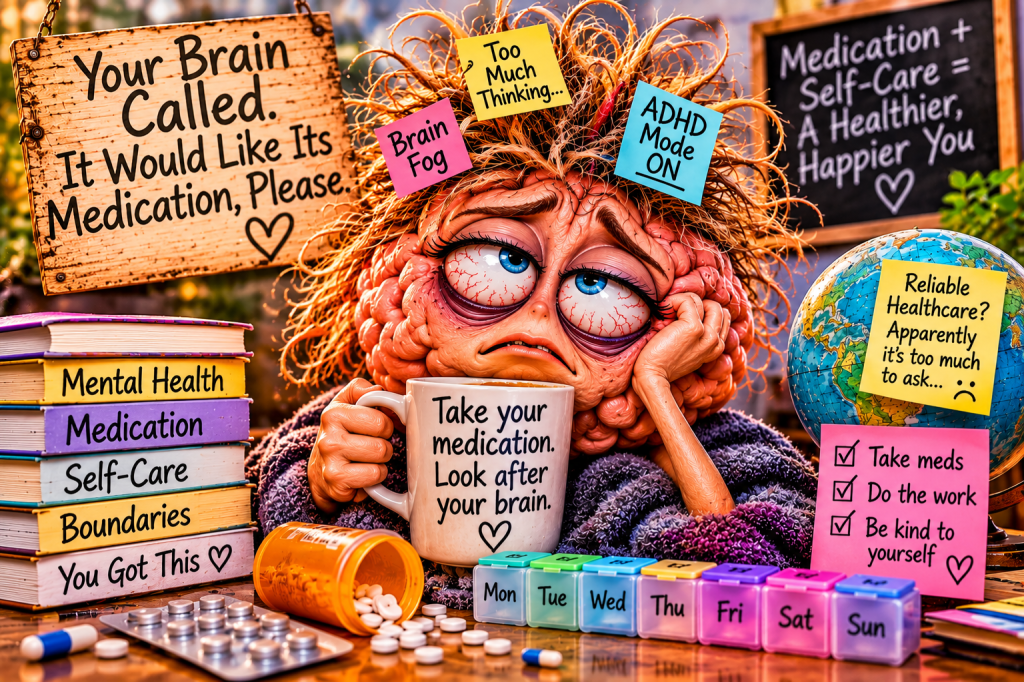
On mental health, medication, personal responsibility, and the rather inconvenient business of trying to stay mentally stable in a country where accessing healthcare can feel like an extreme sport.
By Helene Waters
Let’s talk about medication.
Specifically, the medication prescribed to keep our brains from turning everyday life into an episode of a psychological thriller.
I’m not a doctor. I’m someone who takes tablets every morning and has opinions.
There’s a peculiar attitude surrounding mental health medication. Some people regard it as a weakness. Others think taking antidepressants means you’ve somehow failed at the business of being a functioning adult.
Then there are those who believe that a few deep breaths, a walk in nature and a gratitude journal should sort the whole thing out.
Bless them.
I’m sure their intentions are lovely.
Unfortunately, serotonin doesn’t always give a flying fuck about your gratitude journal.
Mental health is complicated. It is not a personality defect, a lack of discipline, a character flaw or something that can always be resolved by having a better attitude. Sometimes, despite our best efforts, professional intervention and medication are necessary.
And that is perfectly okay.
The medication isn’t decorative. Take it
One of the most important things about prescribed mental health medication is consistency.
Not consistency when you remember. Not consistency when you’re having a bad week. Not consistency until you start feeling better and decide you’ve been cured by your own sheer brilliance.
Consistency.
When medication is prescribed for depression, anxiety, bipolar disorder or other mental health conditions, there is generally a reason for the particular medication, dosage and schedule.
These treatments often need time to work, and maintaining the prescribed routine matters.
Feeling better doesn’t necessarily mean you no longer need the medication.
In fact, sometimes feeling better is precisely the indication that the medication is doing its job.
It’s a little like deciding that because your car has stopped making that alarming noise, you no longer need engine oil. The noise stopped because of the oil. Congratulations, you’ve just created a much more expensive problem.
Stopping medication abruptly, skipping doses or adjusting your dosage without medical guidance can cause problems. Depending on the medication, this may include withdrawal or discontinuation symptoms, a return or worsening of symptoms, or destabilisation of a condition that was previously being managed.
And no, the solution isn’t to double your next dose because you’ve forgotten the previous one.
Medication isn’t a loyalty programme. You don’t collect missed doses and redeem them later.
Check the leaflet or ask your pharmacist what to do when you miss one, because the rules vary.
If you’re struggling with side effects, feel that your medication isn’t working, or want to stop taking it, speak to your prescribing healthcare professional. There are often alternatives, adjustments and safer ways of making changes.
The important thing is not to make those decisions in isolation.
Medication is not a substitute for doing the work
Now, here’s where I want to introduce a slightly different perspective.
Medication is wonderful. Doctors are wonderful. Psychiatrists, therapists and other mental health professionals can be absolutely instrumental in helping people manage their conditions.
But medication, as important as it is, isn’t necessarily the whole story.
Speaking as someone living with Bipolar II and taking mood stabilisers, I know that there’s a certain amount of work I have to do myself.
Medication provides an important foundation. It helps manage the condition and gives me a better opportunity to maintain stability. But it doesn’t automatically make me emotionally intelligent, resolve my personal issues, establish healthy boundaries or magically transform me into someone who makes consistently sensible decisions.
If only.
There is still work to be done.
There is learning to recognise my own patterns, understanding my triggers, paying attention to changes in my mood, establishing routines, prioritising sleep, managing stress and recognising when I need to step back and reassess what’s happening.
There is also the uncomfortable business of looking at yourself honestly, acknowledging the things you need to work on and accepting that sometimes your own behaviour needs a little adjustment.
Medication cannot do that for you.
You can take your tablets religiously and still have unresolved issues.
You can have an excellent psychiatrist and still need to put boundaries in place.
You can be medically stable and still make questionable life choices.
I believe there’s a distinction between managing a mental health condition and actively working towards your overall wellbeing.
Both matter. Neither should be used to dismiss the other.
Think of it as cooking. Medication is the meal. The work is the salt. Skip the salt and nobody’s asking for seconds. Skip the meal and try living on salt alone, gratitude journal in hand, and let me know how that goes.
This is not about suggesting that people can simply think themselves out of a psychiatric condition.
They can’t.
Bipolar disorder, depression, anxiety and other mental health conditions are not cured by positive thinking, personal discipline or an impressive collection of self-help books.
Nor is personal responsibility about blaming yourself when symptoms return or treatment isn’t working.
It’s about recognising that, where possible, you have a role to play in your own care.
Medication can give you a foundation. Professional support can give you direction. But the everyday choices, the self-awareness and the work you do to support your wellbeing are also part of the picture.
You cannot outsource your entire mental health journey to a little tablet.
Although, admittedly, it would be terribly convenient if you could.
And then there’s the small matter of actually GETTING the medication
Because all the advice in the world about maintaining a consistent medication regime is wonderfully helpful when you live somewhere with accessible healthcare, functioning pharmacies, reliable supply chains and medical professionals who can actually help you.
But what happens when you live somewhere where getting your prescribed medication becomes an administrative expedition worthy of a documentary?
Welcome to the developing-world healthcare experience…
Here, the process can sometimes look something like this:
- Your doctor prescribes medication.
- You go to the pharmacy.
- The pharmacy doesn’t have it.
- You try another pharmacy.
- They might have something similar.
- You discover that the alternative is considerably more expensive.
- You consider selling a kidney.
- You remember you’re quite attached to both kidneys.
- You go home and start making phone calls.
And somewhere in the middle of this little adventure, you’re expected to maintain your mental health.
Naturally.
Living in a country with economic instability, limited medical infrastructure and inconsistent access to medication creates challenges that are often overlooked when we talk about mental health treatment.
Medication may need to be imported. Exchange rates fluctuate. Prices increase. Suppliers run out. Pharmacies cannot always obtain stock. Certain medications may simply be unavailable locally.
And if you’re fortunate enough to find what you need, there’s the small inconvenience of paying for it.
Because apparently, being mentally unwell wasn’t expensive enough already.
There is something cruel about being prescribed medication that you know helps you, understanding why you need it, wanting to follow your treatment plan, and then discovering that obtaining it is dependent on circumstances entirely outside your control.
You cannot maintain a consistent medication regime with medication you cannot buy.
It’s not a motivation problem. It’s not a discipline problem. And it certainly isn’t a failure to prioritise your health.
Sometimes, it’s simply a broken system.
Mental health doesn’t understand economics
This is the part that frustrates me most.
Mental health conditions don’t operate according to the national budget.
Depression doesn’t check the exchange rate before making an appearance.
Anxiety doesn’t consult the Ministry of Finance to establish whether this is a financially convenient month to cause havoc.
Bipolar disorder doesn’t wait until the pharmacy has received its latest shipment.
Your brain, unfortunately, is not particularly interested in the state of the economy.
It has its own agenda.
And when medication becomes difficult to access, the consequences can extend well beyond the individual.
There are people working full-time, raising children, managing households, caring for family members and trying desperately to maintain some semblance of normality while privately dealing with mental health challenges.
They are not necessarily visibly unwell. They may be getting the children to school, going to work, attending meetings, cooking supper and remembering to buy toilet paper.
They may even be smiling.
None of that means they’re okay.
And when the medication that helps them manage their condition becomes unavailable, the burden doesn’t magically disappear. It gets added to everything else they’re already carrying.
It’s also worth remembering that not everyone has the financial flexibility to buy several months’ medication in advance, travel to another town looking for stock, or pay privately for an alternative when the prescribed treatment becomes unavailable.
Access to mental healthcare should not be a luxury reserved for people who can afford to navigate an obstacle course.
A little preparation goes a long way
While we cannot personally repair an entire healthcare system — I’ve checked, and apparently that’s not included in the standard adult responsibilities package — there are things we can do to make managing medication a little easier.
If you take prescribed medication for a mental health condition:
- Take it as prescribed, even when you’re feeling well.
- Use an alarm, medication organiser or reminder system if remembering doses is difficult.
- Attach taking it to something you never skip. For me that’s my morning coffee, so my meds live by the kettle.
- Keep track of how much medication you have left.
- Where financially and medically practical, plan ahead for repeat prescriptions rather than waiting until the last tablet.
- Speak to your healthcare professional about what to do if your medication becomes unavailable.
- Ask about clinically appropriate alternatives if supply problems arise.
- Never substitute, stop or change medication without professional guidance.
- Be honest with your doctor about side effects, missed doses and difficulties obtaining medication.
And most importantly, don’t allow embarrassment to stop you from asking for help.
There is no shame in needing medication. There is no shame in struggling. There is no shame in admitting that you’re not coping as well as you would like.
We have somehow managed to normalise taking medication for high blood pressure, diabetes and countless other physical conditions, yet mental health medication still seems to attract an entirely unnecessary amount of judgement.
Your brain is an organ. It deserves healthcare too.
Revolutionary concept, I know.
You don’t get a medal for suffering unnecessarily
I think we need to have a more honest conversation about what looking after our mental health actually means.
It isn’t always yoga, meditation, long walks, bubble baths and inspirational quotes featuring sunsets.
Sometimes it’s making an appointment with a psychiatrist.
Sometimes it’s taking medication every morning.
Sometimes it’s admitting that the medication isn’t working and asking for help.
Sometimes it’s having to make six phone calls because three pharmacies don’t have your prescription in stock and the fourth one wants an amount of money that suggests the tablets have been personally blessed by the Pope.
Sometimes it’s doing the uncomfortable personal work that medication alone cannot do.
And sometimes it’s simply getting through the day.
We need to stop treating mental health medication as something people should be embarrassed about, and start recognising it for what it can be: an important part of managing a health condition and reclaiming some quality of life.
Medication isn’t a personality transplant. It won’t fix your dysfunctional family, pay your electricity bill, make your colleagues less irritating or prevent your country from having another economic meltdown.
Sadly, there are limits to modern medicine.
But for someone who needs it, the right treatment can make an enormous difference.
And that difference matters.
Because people deserve to live their lives, not spend every waking moment fighting their own minds.
One final thought…
If you’re living somewhere where obtaining the medication you’ve been prescribed is an ongoing battle, please understand that this isn’t a personal failure. You deserve reliable access to healthcare, just like everyone else.
We can talk endlessly about awareness, acceptance and breaking the stigma surrounding mental health.
But awareness without access is just another conversation.
And quite frankly, most of us have enough conversations going on inside our heads already.
Take your medication. Look after your brain. Do the work. Be kind to yourself. And if you happen to find a healthcare system that works exactly as advertised, please let the rest of us know where it is.
We’d quite like to visit.
Preferably with a prescription in hand and a pharmacy that actually has stock.
Until next Sunday, take care of yourselves. Your brain has been putting up with you for years. The least you can do is return the favour.


Leave a Reply