

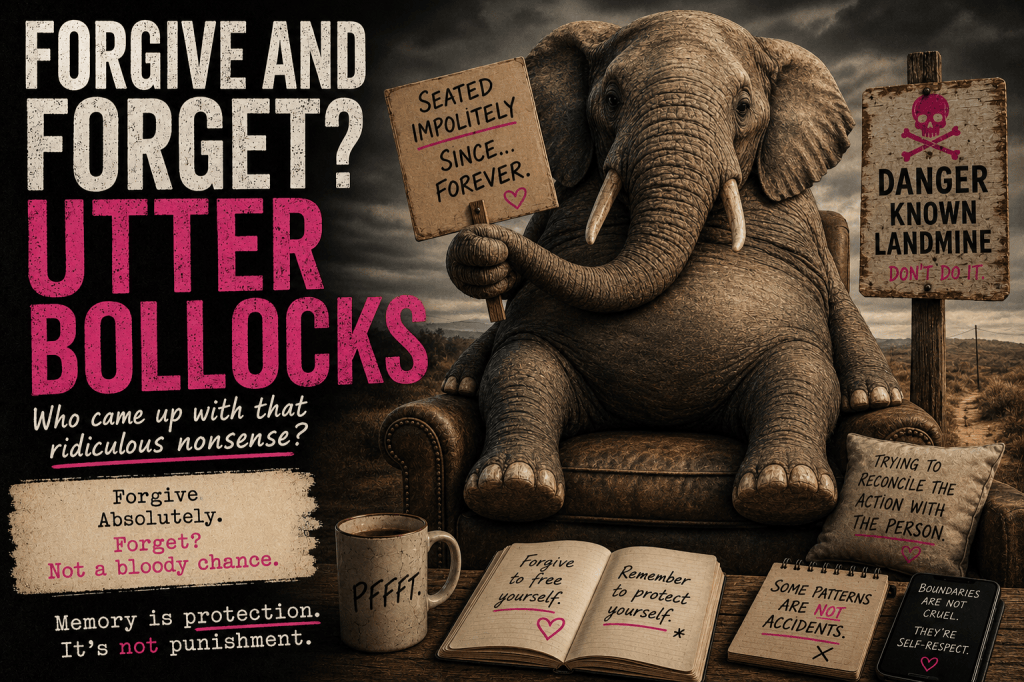
Who came up with that ridiculous nonsense?
By Helene Waters
There are certain phrases society keeps handing out like stale peppermint sweets at church and when I see them written in a text, my finger hovers over the vomit emoji…
“Everything happens for a reason.”
“Time heals all wounds.”
“What doesn’t kill you makes you stronger.”
And my personal favourite…
“Forgive and forget.”
Forgive?
Absolutely.
Forget?
Not a bloody chance.
Because forgetting is seeing the landmine, knowing exactly where it is, and convincing yourself it probably won’t explode this time.
Let’s talk about forgiveness
Forgiveness has never been about letting someone off the hook.
It’s about letting yourself off the hook.
Because anger is exhausting.
It sits inside you.
It grows.
It festers.
It quietly poisons parts of your life that had absolutely nothing to do with the original wound.
Meanwhile, the person who hurt you?
Odds are they’re getting on with life as though nothing ever happened.
You’re the one feeling like an elephant is seated impolitely on your chest while you’re trying to reconcile the action with the person.
Pffft.
My overthinking brain would like to formally reject this entire arrangement.
Holding onto rage is a bit like drinking poison and hoping the other person develops stomach cramps.
It doesn’t work.
So yes…
Forgive.
Not because they deserve it.
Because you deserve peace.
But forget?
This is where I get off the bus.
Because memory isn’t punishment.
Memory is protection.
We remember where the snake bit us.
We remember which dog growled before it attacked.
We remember the road where we nearly had the accident.
Not because we’re bitter.
But because our brains have this extraordinary survival system that society somehow expects us to switch off.
Our brains are literally designed to remember danger.
Which is why this has always fascinated me.
We tell children,
“Don’t touch the hot stove again.”
We teach them to remember pain because memory keeps them safe.
Yet somehow, when adults are betrayed…
Manipulated…
Abused…
Humiliated…
Broken…
We’re told,
“Forgive and forget.”
One is common sense.
The other is somehow considered virtue.
The contradiction has always been a bit ridiculous.
Trauma remembers
I’ve touched briefly on childhood abuse before in The Rooms We Never Left.
I wrote that piece to begin processing my own experiences.
Nearly thirty-four years after they happened.
Because therapy can only take you so far.
And let’s be fair here…
…so can your bank account and medical aid, right?
The real work often begins after the therapy session ends.
It’s found in the quiet, ordinary moments where healing slowly takes root.
When a smell no longer pulls you violently backwards.
When a word doesn’t knock the air from your lungs.
When a place stops feeling like a battlefield.
When your body slowly learns that you survived…
…and that you’re finally safe.
Or when you find someone you can truly feel safe with.
Someone who understands your triggers.
Your pain.
Your heartache.
Someone who doesn’t expect you to be “healed”, “better”, or magically capable of functioning exactly as society expects you to every single day.
Someone who understands that sometimes healing looks like progress…
…and sometimes it looks like simply getting through the day.
Unfortunately, there isn’t a shortcut.
Trauma doesn’t wear a watch.
It doesn’t care how many birthdays have passed or how many people think you should “be over it by now.”
And there’s another important thing to remember…
Neither sexual abuse nor domestic violence is gender-specific.
Many of my readers, both men and women, have survived abuse in one form or another.
Men carry the weight of “Cowboys don’t cry”.
Women carry the weight of “You’re so strong”.
Sometimes healing takes years.
Sometimes decades.
But every single step forward matters.
Here’s the difference
Remembering isn’t the same as reliving.
Remembering isn’t revenge.
Remembering isn’t bitterness.
Remembering is wisdom.
I can forgive someone.
I can genuinely wish them well.
Or not.
I can hope they heal.
Or not.
Standard textbook psychology, religious teaching, and people fortunate enough never to have endured deep trauma can sometimes paint “true healing” as reaching some state of enlightened benevolence where you wish peace, love and light upon the people who destroyed your world.
Lovely idea.
But…
For someone who has actually survived severe abuse, it can feel like one more thing you’re expected to achieve before you’re finally allowed to call yourself healed.
For survivors of severe abuse, the expectation that you should forgive the paedophile…
…the violent partner…
…the manipulator…
…the person who stole your safety…
…can feel like a second assault.
Newsflash.
That expectation implies that if you don’t possess the saint-like capacity to forgive a monster…
…your healing is somehow incomplete.
Or broken.
I don’t buy that.
Not for one second.
So no.
You do not need to wish them well.
You do not need to hope they heal.
Not ever.
However…
You can decide they’ll never again have access to your heart.
Or your mind.
Sometimes forgiveness is letting go without ever telling the person you’ve forgiven them.
Because, to be fair…
Some monsters don’t deserve that mercy.
Sometimes forgiveness simply means refusing to let what they did continue affecting you as viscerally as it once did.
It’s evicting them so they no longer live rent free in your thoughts.
Those things are not contradictions.
They’re healthy boundaries.
Because forgiveness doesn’t erase discernment.
The pattern matters
When someone hurts you once…
Maybe they made a mistake.
Twice?
Perhaps they haven’t learnt.
Seven times?
Congratulations.
You’ve identified a behavioural pattern.
Back in the day, identifying that pattern resulted in one of the most satisfying forms of blocking someone imaginable.
You’d slam the telephone down.
Then pull the phone off the hook.
Power restored.
Nowadays, phones cost approximately the same as a small island, so launching one across the room is a terrible financial decision.
Instead…
When that particular person’s name flashes across your screen and your immediate muscular reflex is to turn your phone face down on the table as though it’s a live piece of unexploded ordnance…
…stop calling it bad luck.
Maybe it’s past time to officially block them.
Because your nervous system is simply reading the data.
Sometimes we become so committed to being compassionate that we ignore evidence tap-dancing in front of us wearing neon lights.
People show us who they are.
Repeatedly.
Our job isn’t to keep pretending we missed it.
Healing isn’t amnesia
The scars on your body don’t disappear simply because the wound closed.
Why would emotional scars be any different?
The scar isn’t there to punish you.
It’s there to remind you:
“This hurt once.”
“Protect yourself next time.”
That isn’t weakness.
That’s intelligence.
A final thought
Forgive.
Absolutely.
Free yourself from carrying hatred that was never improving your life anyway.
But forget?
What, shall I lay out the red carpet and grease the hinges so the next betrayal doesn’t hurt their shoulder kicking the door in?
Remember.
Learn.
Grow.
Protect your peace.
Because healing was never supposed to erase your memory.
It was supposed to teach you how to use it.
After all…
The hottest stove in your life isn’t the one you touched once.
It’s the one you keep convincing yourself won’t burn you this time.


Leave a comment