

Why we can openly discuss diarrhoea at the dinner table but only whisper privately about intimate body parts
By Helene Waters
There is something wonderfully strange about the way adults talk about sex.
Cue Karen clutching her pearls so tightly she turns them into dust.
We can give a detailed, play-by-play account of a dodgy takeaway over Sunday lunch, right down to the consistency, the cramping and the emotional devastation involved, and nobody bats an eye.
Apparently, some subjects are perfectly acceptable dinner-table conversation.
Others require the immediate deployment of euphemisms, nervous laughter and an intense interest in whatever happens to be hanging on the nearest wall.
The Sheldon Cooper Problem

Anyone who has watched The Big Bang Theory knows exactly where this is going.
Poor Sheldon Cooper.
A brilliant theoretical physicist.
A man capable of explaining the mysteries of the universe.
But when it comes to romance and sexuality?
Complete system failure.
His solution?
Replace ordinary language with something so painfully clinical that every ounce of romance evaporates.
“Sex” becomes “Coitus“.
Yes.
Coitus.
The least seductive word ever created.
It doesn’t sound romantic.
It sounds like either a skin condition or something your GP prescribes antibiotics for.
Nobody has ever dimmed the lights, gazed lovingly into their partner’s eyes and whispered:
“Darling… would you care to engage in coitus?”
Unless their goal was ensuring absolutely nobody became aroused.
And Sheldon isn’t entirely alone in this.
A surprising number of perfectly functional adults have their own version of the same response.
We can discuss sex in theory.
We can joke about it.
We can consume it in films, television, advertising and music.
But when we’re actually required to talk honestly about bodies, desire, comfort or what we want?
Suddenly everyone discovers an urgent appointment somewhere else.
Strange Yet Perfectly Accepted Phrases
So, naturally, we’ve developed an entire vocabulary to help us avoid saying what we actually mean.
We don’t say sex.
We say:
“Doing the deed.”
What deed?
Is there paperwork?
“Netflix and chill.”
Netflix never asked for this responsibility.
“Knocking boots.”
The boots remain entirely innocent.
“The birds and the bees.”
Neither birds nor bees volunteered for this educational assignment.
Humanity looked at one perfectly natural part of adult life and apparently decided:
No. Straightforward language is far too dangerous.
So we invented euphemisms.
Lots of them.
And then somehow taught generations of people that the actual words were the embarrassing part.
Bodies Are Weird
Here’s the part we rarely acknowledge.
Bodies don’t always cooperate.
Sometimes a man is dealing with erectile dysfunction.
Sometimes medication has flattened someone’s libido.
Sometimes menopause arrives like an uninvited demolition crew.
Sometimes anxiety has decided that arousal is optional.
Sometimes trauma changes the way a body responds.
None of those things mean love has disappeared.
None of them mean attraction has vanished.
They simply mean…
Bodies can be spectacularly inconvenient.
Desire changes.
Hormones change.
Medication can change things.
Stress can change things.
Age can change things.
Life can change things.
Sometimes the body simply refuses to follow the script we had in our heads.
And that can be confusing.
It can be frustrating.
Sometimes it can even make people question whether something is wrong with their relationship.
But a body changing doesn’t necessarily mean love has changed.
A different sexual experience doesn’t automatically mean attraction has disappeared.
Sometimes intimacy simply needs to look different from what we expected.
It may require patience.
Communication.
Creativity.
Understanding.
Sometimes medical support.
Sometimes simply taking the pressure off.
Relationships aren’t microwave dinners.
There isn’t a “Start” button.
Desire doesn’t magically arrive ninety seconds later with a cheerful little ping.
Bodies are complicated.
People are complicated.
Perhaps we should stop expecting either to behave like instruction manuals.
The Blue Pill Gets All the PR
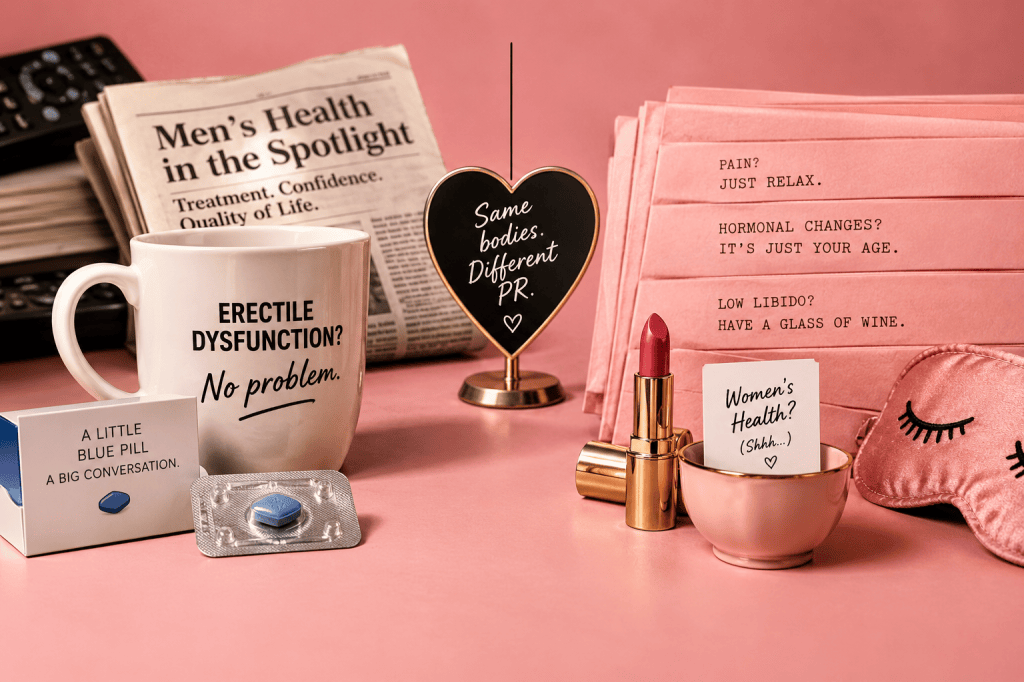
There is also a strange imbalance in how we talk about sexual wellbeing.
Male sexual difficulties are increasingly discussed as health issues.
Erectile dysfunction has advertisements.
Medical advice.
Treatment options.
Conversations.
Women have historically had far less space to talk openly about their own sexual wellbeing.
Pain can be dismissed.
Changes in desire can be dismissed.
Menopause can be treated as though a woman has simply reached the end of her useful settings.
And sometimes the advice is little more than:
“Just relax.”
Which is spectacularly unhelpful when your body has apparently declared war on you.
Women’s comfort, pleasure and sexual wellbeing deserve the same seriousness we give every other aspect of health.
Not because sex is everything.
But because sexual wellbeing is still wellbeing.
And being able to talk about it shouldn’t require a permission slip.
Knowing Your Own Body

We’re surprisingly bad at this.
We spend years learning how our cars work.
We know which foods don’t agree with us.
We know when we’re getting sick.
We know exactly which pillow is the good pillow and which one is responsible for ruining our neck.
But when it comes to our own bodies?
Suddenly we’re expected to operate them without an instruction manual.
Understanding your own body isn’t selfish.
It’s information.
Knowing what feels comfortable, what doesn’t, what has changed and what you need is part of looking after yourself.
And when intimacy is involved, that knowledge becomes communication.
Nobody else automatically knows what your body needs.
They aren’t mind readers.
They’re learning you.
Being able to say:
“I like that.”
“Not quite.”
“Slow down.”
“Stop.”
Or simply:
“I’m not sure.”
isn’t awkward.
It’s healthy.
That’s how two people learn each other.
We’ve made talking about bodies so uncomfortable that sometimes people are expected to understand one another without actually talking.
Humanity invented language for precisely this purpose.
We should probably use it.
The Bottom Line
Sex isn’t the whole of intimacy.
Never has been.
Never will be.
But it can be a beautiful, ridiculous, joyful part of it.
Healthy intimacy requires many of the same things as every healthy relationship.
Trust.
Respect.
Honesty.
Safety.
Consent.
And perhaps occasionally…
the emotional maturity to use proper words without requiring a secret decoder ring of euphemisms.
We don’t need to turn every conversation about sex into a medical lecture.
We don’t need to make it vulgar.
We don’t need to make it embarrassing.
We just need to be able to talk about it like adults.
Because bodies are human.
Intimacy is human.
Desire is human.
And perhaps the strangest thing of all is that we’ve somehow convinced ourselves that talking about being human is the embarrassing bit.
Maybe we don’t need to whisper.
Maybe we don’t need code words.
Maybe we don’t need to call it coitus as though we’re writing a nineteenth-century medical journal.
Maybe…
just maybe…
two adults can have an adult conversation.
And nobody has to die of embarrassment.


Leave a comment