
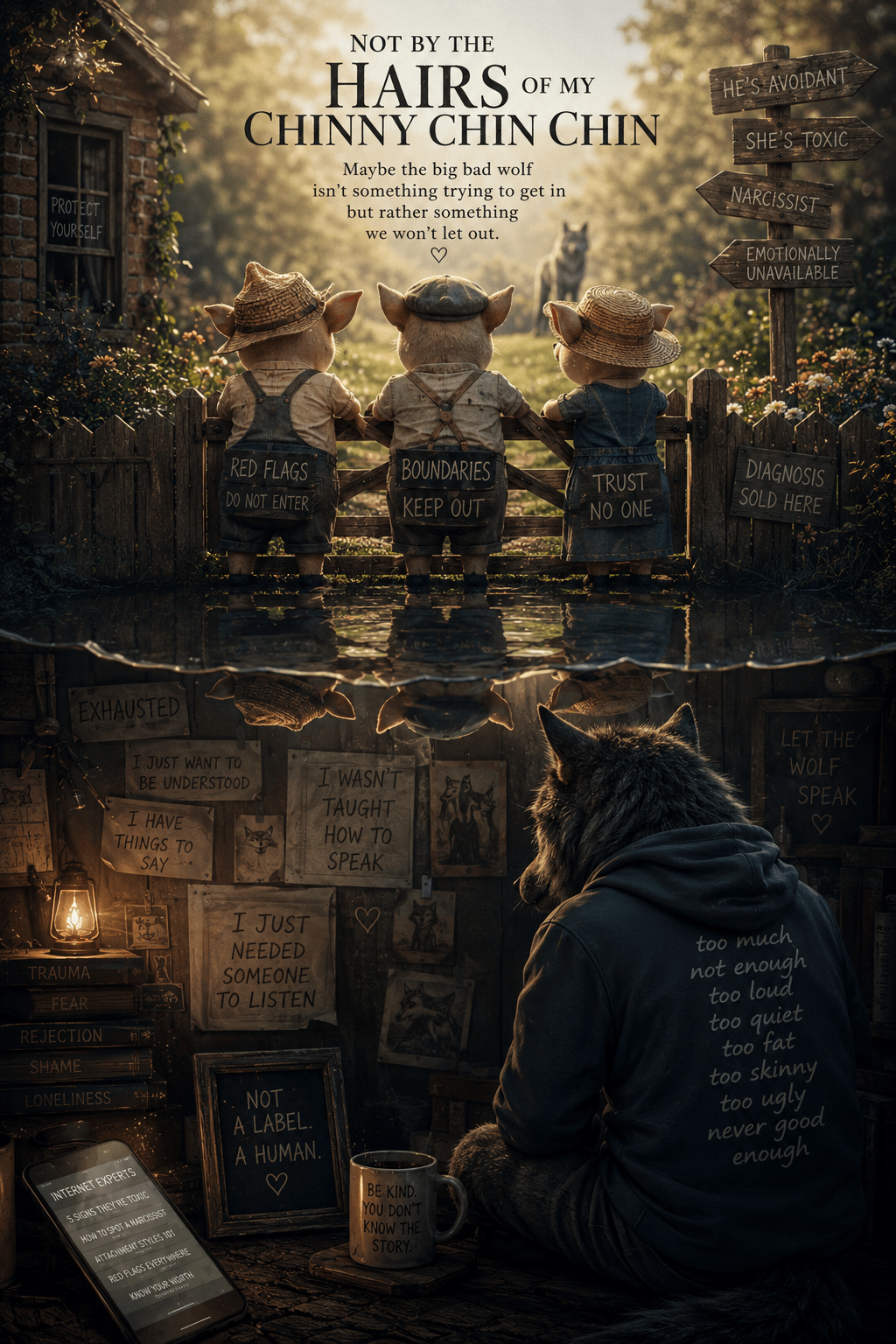
By Helene Waters
We all know the story of the Three Little Pigs.
The Big Bad Wolf arrives at the door, huffing and puffing, ready to blow the little piggies’ houses down.
And the piggies stand firm:
“Not by the hair on my chinny chin chin.
I’ll not let you in.”
A childhood story.
A wolf outside.
A door closed.
A threat kept away.
Except…
Maybe adulthood is not quite that simple.
Because these days, we have a different kind of wolf.
Not one with big teeth and dramatic breathing.
One with WiFi.
One that lives in our phones.
One that tells us it knows everything about everyone.
Everyone is an expert now
Tick tock.
YouTube.
Facebook.
Google.
The internet.
Social media.
A never-ending stream of people who know things about things.
They teach you what to look for.
The signs.
The red flags.
The hidden messages.
The secret meanings behind someone’s behaviour.
“He’s avoidant.”
“She’s a narcissist.”
“He’s emotionally unavailable.”
“She’s toxic.”
“He’s this.”
“She’s that.”
Apparently, all it takes now is a 30-second video, a catchy background song and someone saying:
“Here are five signs you are dealing with a dangerous person…”
And suddenly we are all qualified.
Move over psychologists.
Move over therapists.
The internet has arrived with a ring light and a microphone.
And it has answers.
Now, before anyone thinks I’m dismissing genuine help:
I’m not.
There are incredible professionals online.
There are legitimate resources.
There are people sharing valuable information about trauma, mental health, relationships and human behaviour.
Those voices matter.
But…
There is also a very loud corner of the internet where confidence has replaced qualification.
Where people diagnose strangers based on a paragraph.
A message.
A bad day.
A misunderstanding.
And somehow we forget something incredibly important:
People are complicated.
Maybe they aren’t the villain
Maybe the person you are labelling is not trying to hurt you.
Maybe they are not playing games.
Maybe they are not manipulating you.
Maybe they are simply unable to speak.
Not because they have nothing to say.
But because somewhere along the way, they learned that saying what they felt came with consequences.
Maybe silence is not always punishment.
Maybe distance is not always rejection.
Maybe someone pulling away is not because they do not care.
Maybe they are overwhelmed.
Maybe they are scared.
Maybe they are fighting a battle nobody else can see.
The internet therapist versus the human being
We have become very good at finding faults.
Very good at spotting problems.
Very good at collecting evidence.
Someone takes too long to reply?
Red flag.
Someone needs alone time?
Avoidant.
Someone struggles to communicate?
Toxic.
Someone has boundaries?
Difficult.
Because apparently being a fully formed human being with emotions, history, fears and flaws is now suspicious behaviour.
The irony?
We demand people understand our trauma while refusing to consider theirs.
We want grace for our bad days but evidence against everyone else’s.
Funny how that works.
The Playground Bully With A Helping Sticker
Somewhere along the way, we have become a strange version of the playground bully.
Except now we disguise it.
We wrap it in pretty words.
“I’m just trying to help.”
“I’m just pointing out the signs.”
“I’m just protecting you.”
“I’m just educating myself.”
And sometimes?
Sometimes we genuinely are trying to help.
But sometimes we are just judging people with a motivational quote slapped on top.
Because calling someone toxic sounds far nicer when you add:
“Know your worth 🤗”
Apparently, if you put enough sparkles on an opinion, it becomes advice.
Who knew?
The problem is that we are slowly forgetting how to trust ourselves.
We Google.
We scroll.
We search.
And then Dr Google says:
“X means Y.”
So therefore it must be true.
Because obviously the internet would never confidently tell us something incorrect.
Except…
It does.
Constantly.
Even AI has a built-in reminder that mistakes happen.
That information needs context.
That it is not a replacement for a professional.
That human beings are complicated.
Yet somehow we are trusting Sally from Facebook who watched an influencer explain attachment styles while her dog walked past in the background…
And suddenly Sally knows that Dave is avoidant because he likes his weekends alone.
Or Karen knows Lisa is toxic because Lisa said “no” once.
Or someone’s goldfish has apparently diagnosed their entire relationship from inside a bowl.
Which is impressive.
Honestly.
The goldfish has more authority than some comment sections.
Put down the phone
So maybe, instead of sitting on our tuffits scrolling through our phones, hoping to earn a PhD in five minutes from the University of TikTok Psychology…
We stop.
We look.
We listen.
Really listen.
Not just to what someone says.
But to what they don’t say.
The pauses.
The changes in tone.
The things they avoid.
The things they struggle to explain.
Because hidden underneath all the things we are so quick to judge could be someone exhausted.
Someone who has spent years feeling:
Too fat.
Too skinny.
Too ugly.
Too loud.
Too quiet.
Too emotional.
Not emotional enough.
Too much.
Not enough.
Someone who has spent their entire life wondering why they never seem to fit into the shape the world expects them to be.
And then we sit.
We judge.
We label.
We decide who they are.
Why?
What makes that okay?
When did curiosity become criticism?
When did understanding someone become less important than categorising them?
The lamb to the slaughter
Because vulnerable people are easy to influence.
People who are hurt.
People who are confused.
People desperate for answers.
They are the lambs walking into the field while the wolves promise they are protecting them.
Certainty is a dangerous thing when it comes without wisdom.
Because the truth is:
A label can become a cage.
For the person being labelled.
And sometimes for the person doing the labelling.
Final Thoughts
Maybe the Big Bad Wolf was never always the thing trying to get in.
Maybe sometimes the wolf is the thing we are terrified to let out.
The anger we swallowed.
The grief we buried.
The truth we never spoke.
The parts of ourselves we were told were too much.
Maybe the door was never only keeping something out.
Maybe it was also keeping something trapped inside.
And maybe healing is not about destroying the wolf.
Maybe it is about finally letting it speak.



Leave a comment