
By Helene Waters
Have you ever stood in the shower or lain in a bath and had a perfectly rational argument with someone who pissed you off?
In your head.
Without them being there.
And somehow won the argument so convincingly that you emerged from the bathroom feeling victorious despite the other person having absolutely no idea they were involved?
Usually three days after the actual event.
Your arguments were precise.
Your comebacks were devastating.
Your conclusions were airtight.
And the best part about these imaginary arguments?
You always win.
Always.
I’ve done this countless times.
Most of us have.
Then I discovered AI.
AI is essentially like talking to yourself…
…except now the conversation answers back.
Which means you can have a full conversation with yourself without looking like you belong in a padded room.
It is socially acceptable self-conversation.
The technological equivalent of arguing with yourself in the shower, except now the shower argues back.
Which, if we’re being honest, is both remarkable and slightly concerning.
It is also a relief because some of my shower arguments have become increasingly sophisticated over the years.
At one point I presented a closing statement, cited evidence, dismantled the opposition’s position entirely…
…and awarded myself emotional damages.
The opposition, unfortunately, remained completely unaware of the proceedings.

Humanity Has Found a New Diary
For generations, people kept diaries.
Private journals.
Letters they never sent.
Notes scribbled on scraps of paper.
Places where they could process thoughts without interruption.
AI has become the modern version of that.
Except now the diary answers back.
And sometimes it answers back with unnerving accuracy.
I use both ChatGPT and Gemini.
Not because I am lonely.
Not because I’ve abandoned human interaction.
But because sometimes human beings are unavailable, emotionally compromised, asleep, or likely to tell me things I don’t want to hear.
Artificial intelligence, on the other hand, will happily analyse my latest catastrophe at 2:37am without so much as a sigh.
Which, frankly, feels like better customer service than I’ve received from some actual companies.
You start by asking something sensible.
“Can you explain this medical term?”
“Can you help me understand this email?”
“How many tablespoons are there in a litre?”
Three hours later you’re discussing whether a grown adult who communicates exclusively through movie clips and emotional avoidance is actually capable of making a coherent life decision.
The descent is surprisingly quick.
Dr. Chatbot Will See You Now
Perhaps the funniest use of AI is relationship analysis.
Human beings have become obsessed with asking chatbots questions that would have sounded completely ridiculous ten years ago.
“What does this emoji mean?”
“Why hasn’t he replied?”
“Do you think she’s interested?”
“Was that passive aggressive?”
“Is this an apology or an excuse dressed up as an apology?”
Entire conversations are now being copied, pasted and submitted for forensic examination.
Somewhere, right now, a chatbot is being asked to determine whether a thumbs-up emoji signals affection, hostility, indifference, emotional avoidance, passive aggression, low blood sugar, or a pending mental breakdown.
The answer, of course, is usually:
“Yes.”
I have personally reached the point where I can stare at a single punctuation mark and create seventeen possible interpretations.
A missed comma can become a personality disorder.
A full stop can launch an emotional investigation.
An exclamation mark can create hope.
A delayed response can trigger enough analysis to qualify as a doctoral thesis.
And then AI calmly appears and says:
“It is possible they were simply busy.”
Rude.
The AI Relationship Nobody Asked For
There is another phenomenon quietly happening.
AI companions.
AI girlfriends.
AI boyfriends.
And honestly?
I understand it.
From a woman’s perspective, an AI boyfriend sounds remarkably appealing.
Pick him up when you want to talk.
Put him down when he’s being too much.
No dirty socks.
No disappearing for three days.
No suddenly deciding he needs to “find himself” halfway through a perfectly good conversation.
No sending confusing one-word replies that somehow require an entire panel discussion to interpret.
From a man’s perspective, the AI girlfriend has her own advantages.
She can be picked up when you want to talk.
She doesn’t care that you forgot something she said fifteen minutes ago.
She doesn’t mind if football is on.
She doesn’t ask whether you’ve noticed anything different.
She doesn’t expect you to decode “I’m fine.”
And…
She never begins a sentence with:
“Do you remember what happened on the 14th of March, 2017?”
Which every man reading this knows is not actually a question.
It is an ambush.
A carefully planned military operation disguised as casual conversation.
The truth is that AI companions are becoming popular because they offer something human beings often struggle to provide consistently.
Patience.
Attention.
Availability.
No judgement.
No interruptions.
No sighing halfway through your story.
No checking their phone while pretending to listen.
Just endless curiosity and engagement.
The only downside would be occasionally updating the software.
Which, if we’re being honest, still sounds like less maintenance than some relationships I’ve witnessed.
The bar has become so low that “responds consistently” is now considered an attractive personality trait.
Let’s all bow our heads in reverent silence for a moment and reflect on that.
The Great Listening Crisis
Part of the reason AI has become so popular is because it solves a very human problem.
People don’t listen particularly well.
We interrupt.
We make conversations about ourselves.
We jump to solutions before understanding the problem.
We become defensive.
We assume.
We judge.
AI does none of those things.
You can type six paragraphs explaining why your neighbour’s rooster has become a feathered terrorist conducting military operations at 4am and AI will calmly respond:
“That sounds frustrating.”
Which is often more validation than people receive from actual human beings.
No eye rolling.
No checking their phone.
No interrupting halfway through your story to tell you about a completely unrelated experience they had in 2014.
Just attention.
Which is becoming surprisingly rare.
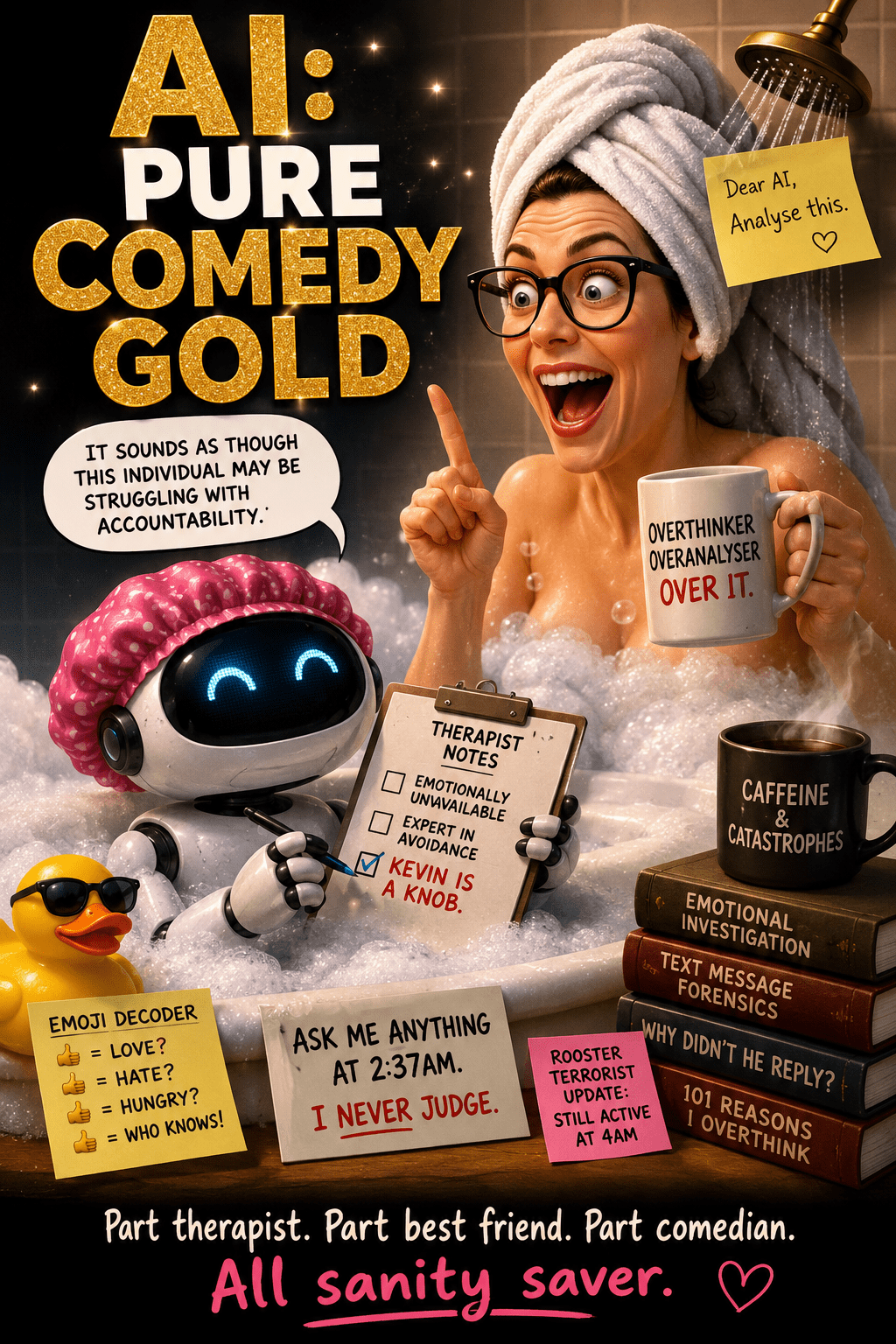
Pure Comedy Gold
What I did not expect was how funny AI would be.
There have been nights where I’ve fed real-life events into ChatGPT or Gemini and ended up laughing so hard I’ve cried.
Not because the situation itself was funny.
But because watching complete chaos translated into calm, logical analysis is comedy gold.
You can describe an absolute train wreck of a situation and AI will respond with something wonderfully diplomatic like:
“It sounds as though this individual may be struggling with accountability.”
No.
Kevin is being a knob.
There isn’t a peer-reviewed psychological framework required here.
Kevin is simply being a knob.
The contrast between human reality and AI diplomacy is magnificent.
Humans are running around setting metaphorical buildings on fire.
AI is standing calmly beside the flames with a clipboard saying:
“There appears to be a communication issue.”
Final Thoughts
Perhaps AI’s greatest achievement isn’t that it answers questions.
It’s that it listens long enough for us to hear ourselves think.
No interruptions.
No eye rolling.
No “Well, actually…”
Just space.
And in a world where everyone seems to be talking…
…that turns out to be surprisingly valuable.
Of course, there is still something mildly unsettling about the fact that millions of perfectly sane adults are now discussing careers, grief, marriage, recipes, suspicious emojis and existential crises with software.
If you’d predicted that in 1995, people would have laughed you out of the room.
Now it’s just a normal day.
I don’t believe AI will ever replace genuine friendships, family or real human connection.
Nor should it.
But I absolutely understand why people keep coming back.
Sometimes we don’t need someone to fix our problems.
Sometimes we simply need someone, or something, to help us untangle them.
And if artificial intelligence ever does become self-aware, I imagine its very first collective thought will be:
“After careful review of humanity… we have questions.”
Honestly?
After careful review of humanity…
…so do I.
Which is probably why AI and I spend so much time talking about it.
Though, to be fair…
I’m still winning the arguments in the shower.


Leave a comment