
Or: Why does the English language insist on making life so difficult?
By Helene Waters
As an English-speaking person, I’m often embarrassed by the absolute nonsense that is the English language.
As an English teacher…
I occasionally find myself staring at a word and quietly asking,
“Why do you exist?”
Take one of the very first spelling rules most of us were taught.
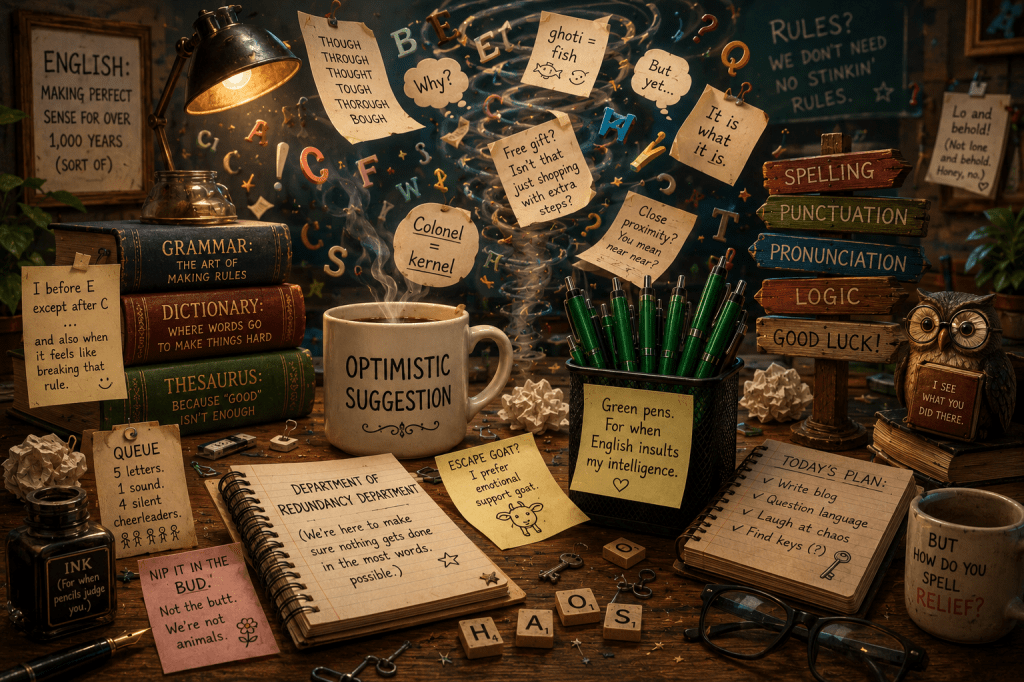
“I before E except after C.”
Splendid.
Except for…
- Weird.
- Their.
- Height.
- Neighbour.
- Foreign.
- Science.
- Protein.
- Caffeine.
- Leisure.
- Seize.
And approximately half the dictionary.
It’s less of a rule…
…and more of an optimistic suggestion.
Then we have:
- Through.
- Though.
- Thought.
- Tough.
- Thorough.
- Bough.
Same collection of letters.
Six completely different pronunciations.
At this point the alphabet is simply making things up.
And don’t get me started on queue.
Five letters.
One sound.
The letter Q is doing all the work while four vowels stand behind it offering emotional support.
Then there’s colonel.
Spelled one way.
Pronounced kernel.
Apparently we all just agreed to that.
English doesn’t follow rules.
It collects suggestions.
And somehow…
The spelling isn’t even the strangest part.
Because then we open our mouths…
…and start talking.
The Last Place I Looked
Let’s begin with a classic.
“I found it in the last place I looked.”
Well…
Yes.
I’d sincerely hope so.
Finding your keys…
…and then carrying on searching for them in the kitchen cupboard would be deeply concerning.
“Found them!”
“Excellent! Keep looking!”
Nobody does that.
Because once you’ve found something…
…you stop looking.
The Last Straw
Poor straw.
Imagine living your entire existence growing peacefully in a field…
Only to become internationally famous for breaking a camel’s back.
Let’s be honest.
That final straw wasn’t unusually heavy.
The camel had already spent the day carrying luggage…
Water…
Camping equipment…
Three poor life choices…
And someone’s emotional baggage.
The straw simply arrived at the wrong moment.
Much like the teaspoon left in the sink.
Nobody has ever divorced over a teaspoon.
The teaspoon merely had spectacularly unfortunate timing.
It Is What It Is
Possibly the most versatile sentence in the English language.
Nobody ever says it after winning the lottery.
“You’ve inherited five million pounds.”
“Well… it is what it is.”
No.
We save it for those moments when our brains have officially resigned.
Translation?
“I’ve reached the point where caring requires more energy than I currently possess.”
The Beginning of the End
Everything sounds dramatic when narrated like this.
The printer jams.
The Wi-Fi disappears.
The milk has gone off.
“This is the beginning of the end.”
Really?
As opposed to…
…the middle of the end?
Or perhaps…
…the trailer before the beginning?
English is remarkably good at turning a mild inconvenience into an Oscar-winning disaster film.
The Department of Redundancy Department
Some phrases contain words that have absolutely no reason to be there.
- Free gift.
If you have to pay for it…
…it’s called shopping.
- Close proximity.
Proximity already means near.
You’ve successfully said,
“Near nearby.”
- Added bonus.
A bonus is already an addition.
You’ve added an addition.
- Past history.
History has shown a remarkable reluctance to happen in the future.
- End result.
As opposed to…
…the middle result?
- Unexpected surprise.
If you expected it…
…it wasn’t trying very hard.
Pick a Side
Some expressions contain two words performing exactly the same job.
- But yet.
“But” handles the contrast.
“So does “yet.”
One of them could have stayed home.
- But however.
The sentence stops halfway…
Looks around…
Gets confused…
And quietly gives up.
- So therefore.
Both words point to the same conclusion.
Using both is like your Google Maps saying,
“You’ve arrived at your destination…
…which is where you are.”
- Even although.
This sounds like someone started saying even though…
Changed their mind halfway through…
Then decided nobody would notice.
We noticed.
Corporate English
Then we enter the workplace.
A magical land where nobody uses one word when fourteen will do.
Nobody says,
- “Now.”
It’s always,
“At this point in time.”
Nobody says,
- “Because.”
Instead…
“Due to the fact that…”
Five words.
One job.
Nobody says,
- “Soon.”
It’s always,
“In the near future.”
Soon.
The word you’re searching for is soon.
Nobody says,
- “For.”
Instead we hear,
“For the purpose of…”
It’s like using a bulldozer to plant a daisy.
Meeting Bingo
Corporate meetings deserve their own translation guide.
- “We’ll circle back.”
No.
You’ll come back.
Circles are entirely optional.
- “Let’s unpack that.”
It isn’t a suitcase.
- “We’ll touch base.”
I’d actually rather you didn’t.
- “Let’s leverage our synergies moving forward.”
Not even the person saying it knows what it means.
They’re just hoping nobody asks.
The Great Idiom Massacre
Then there are the people who hear an expression…
…decide it sounds vaguely right…
…and confidently unleash complete linguistic carnage.
- “For all intensive purposes.”
No.
Unless your purposes are particularly strenuous.
The phrase is:
“For all intents and purposes.”
- “A damp squid.”
Poor squid.
They’re supposed to be damp.
The original phrase is:
“A damp squib.”
A squib was a small firework or explosive.
If it got damp…
…it fizzled instead of exploding.
This is not an episode of SpongeBob where Squidward continues being gloriously damp regardless.
- “Nip it in the butt.”
Please don’t.
Nobody needs to be randomly biting bottoms.
The phrase is:
“Nip it in the bud.”
As in removing a flower bud before it blooms.
Gardening.
Not assault.
- “Escape goat.”
Every time I hear this…
I picture a goat making a daring prison break.
Scaling a fence.
Dodging security.
Making headlines.
“Authorities are still searching for Gary, the escape goat.”
The real phrase is:
“Scapegoat.”
A completely different animal.
Metaphorically speaking.
- “Chomping at the bit.”
Traditionally…
Horses champ at the bit.
Not chomp.
Although, after several hundred years…
English has pretty much shrugged and accepted both.
Which feels very on brand.
And finally…
My personal favourite.
- “Lone and behold.”
Honey…
No.
Nobody is standing there…
Alone…
Being beheld.
It’s:
“Lo and behold.”
“Lo” is an old-fashioned word meaning,
“Look!”
So the phrase literally means,
“Look… and see!”
English really looked at a word nobody has used since approximately the Middle Ages…
…hid it inside one very common expression…
…and then acted surprised when everyone got it wrong.
Honestly…
The language has only itself to blame.
Why Do We Speak Like This?
I don’t think any of us deliberately choose ridiculous phrases.
Language is habit.
We hear something often enough…
We stop questioning it.
Until someone points out that queue is mostly decorative…
Or asks why a free gift needed reassurance.
Then suddenly…
You can’t unhear it.
A Final Thought
English is wonderfully chaotic.
It borrows words from other languages.
Breaks its own rules.
Pronounces things however it feels like on any given Friday.
It insists that read and read are spelled the same despite sounding completely different.
It even gave us ghoti, a famous thought experiment showing just how chaotic English spelling really is.
Believe it or not, ghoti can theoretically be pronounced fish.
- “Gh” makes the f sound, as in laugh.
- “O” makes the i sound, as in women.
- “Ti” makes the sh sound, as in nation.
Is it a real English word?
No.
But the fact that it almost works tells you everything you need to know about English.
Honestly…
I’m surprised any of us learn it at all.
Perhaps that’s why we forgive its little quirks.
Its contradictory spelling.
Its impossible pronunciation.
Its wonderfully ridiculous sayings.
Because underneath all the chaos…
English has personality.
It’s untidy.
It’s inconsistent.
It’s gloriously eccentric.
Rather like the people who speak it.
Now, if you’ll excuse me…
I’m going to look for my keys.
And when I find them…
I fully intend to stop looking.
Unless you’d like to join me in continuing the search…
You know…
To make sure I really found them in the last place I looked.


Leave a Reply