
By Helene Waters
The world has changed.
Visibly changed.
I see it every day in my classroom.
I’m a teacher, and my students are deeply precious to me. Every single one.
They make me laugh constantly. Proper belly laughs too. The kind that catch you off guard because children possess a level of quick humour and observational wit adults often underestimate.
But they are also constant reminders that the world they are growing up in is very different from the one I knew as a child.
Recently, after exams, I gave my students some free time to relax and decompress.
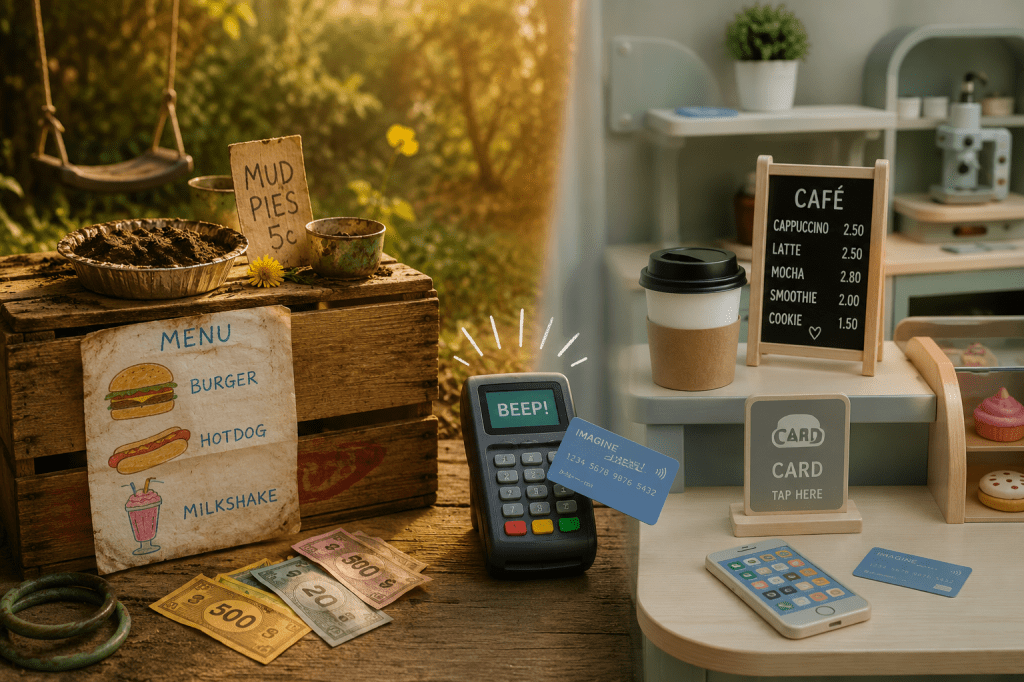
Naturally, they decided to play “shop.”
And watching them felt strangely surreal.
When We Played Shop
When I was a child, playing shop was simple.
We used Monopoly money.
The menu usually consisted of imaginary burgers, chips, hotdogs and perhaps something wildly ambitious like a milkshake.
The drinks list rarely extended beyond:
- water from the garden hose
- Or, juice if someone’s imaginary household happened to be particularly wealthy
That was it.
Simple. Childlike. Uncomplicated.
But my students?
Their pretend restaurant had a menu extensive enough to rival a small franchise.
There were burgers. Chicken buckets. Prawns. Pretzels. Crisps. Sparkling water. Tea. Coffee. Cappuccinos.
One child proudly handed me a handwritten drinks menu with “cappuccino” spelled so creatively (“Kapoocheenoo”) that I had to fight to maintain professional composure while internally collapsing.
But none of that was the moment that stayed with me.
The moment that genuinely stopped me was at the end of the meal.
One of my students looked up at me and asked:
“Mrs Waters, will that be cash or card?”
Card.
At eight years old, that possibility would never even have entered my imagination.
And then, with complete seriousness, they held out an imaginary card machine.
Tapped the imaginary card.
And made the little “beep” sound themselves.
And suddenly I realised just how profoundly childhood itself has changed.
The Childhoods We Grew Up In
But something else sat with me too.
Watching them play so freely with me sitting amongst them felt deeply unfamiliar in a way I struggled to explain at first.
Because when I was their age, school felt very different.
Rigid. Strict. Structured almost entirely around obedience.
There were boundaries everywhere and very little softness inside them.
Corporal punishment was normal. I had rulers brought down across my hands more times than I can count.
Not because I was intentionally naughty.
But because I was misunderstood.
My mind worked differently. I questioned things. Thought differently. Processed differently. And in those days, there was very little room in classrooms for children who did not fit neatly into expected boxes.
Teachers certainly did not sit laughing and playing games with students.
There was distance.
Authority.
Fear, sometimes.
And yet here I was years later in my own classroom, surrounded by fifteen relaxed, laughing little faces, watching them invent coffee shops with imaginary card machines and wildly overpriced pretend kapoocheenoos.
And for a moment, I quietly realised something extraordinary.
The world has changed.
Not always for the better. But not always for the worse either.
The Children Growing Up Now
Modern children face pressures my generation never experienced.
Constant stimulation. Technology. Social media. Overexposure. A world that moves frighteningly quickly.
They are growing up far too aware of things children should arguably still be protected from for a little longer.
But they are also growing up in environments where many feel emotionally safer than previous generations ever did.
They ask questions more freely.
They speak more openly.
They laugh with their teachers.
They are often encouraged to express emotion rather than suppress it.
And perhaps that matters more than we realise.
Because while my generation learned resilience through survival, many of us also learned fear, silence, masking and emotional distance far too early.
These children are different.
Their world is different.
And sometimes, sitting in a classroom listening to children make imaginary “tap and go” sounds while ordering pretend cappuccinos, you realise you are watching an entirely new version of childhood unfold in real time.
Not better.
Not worse.
Just different.
The Future They Are Growing Into
And as I sat there listening to children make imaginary “tap and go” sounds over plates of invisible prawns and kapoocheenoos, another thought quietly crossed my mind.
I found myself wondering how many of these bright, creative little souls would grow up still fully using their imagination in everything they do…
and how many would one day rely almost entirely on AI to think, create, write, solve and imagine for them.
How much bigger will the world of technology become by the time they are adults?
What will childhood even look like then?
And strangely, my heart broke and swelled all at once.
Because their world, so very different from the one I grew up in, has become easier in some ways and infinitely harder in others.
They have access to information, technology and opportunities my generation could scarcely have dreamed of.
But they are also growing up faster. Seeing more. Processing more. Carrying pressures we never had to carry as children.
Everything is instant now.
Entertainment. Connection. Validation. Answers.
And while technology has opened extraordinary doors, part of me wonders what happens to imagination when fewer children are forced to sit in boredom long enough to create entire worlds from Monopoly money, garden hoses and badly drawn menus.
Perhaps every generation mourns the version of childhood it once knew.
And perhaps every generation also quietly fears the world the next one is inheriting.


Leave a comment