
By Helene Waters
We have all seen the videos.
A man standing on a roof holding a garden chair for reasons nobody fully understands.
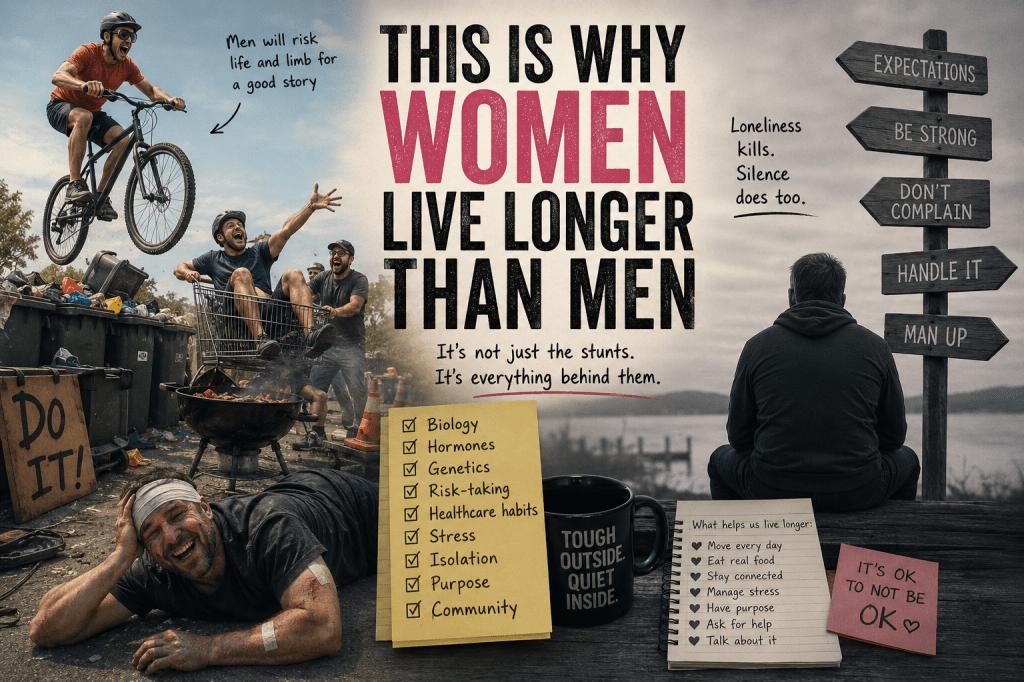
Another attempting to jump a bicycle over twelve bins, a barbecue, and what appears to be a complete absence of basic common sense.
Someone named Kyle willingly being launched from a shopping trolley into a hedge while his friends provide emotional support by screaming: “DO IT!”
Having two brothers taught me very early on that men are capable of levels of reckless confidence that should probably require supervision.
And when my brothers and late husband got together, chaos was almost guaranteed.
Someone would inevitably end up injured.
Not critically injured, usually. Just injured enough to produce limping, unnecessary bandages, missing eyebrows, or a story beginning with: “Right, so technically what happened was…”
And somehow, the injury itself was never the memorable part.
The reason behind it was.
The kind of story that gets retold for years while everyone laughs so hard they can barely breathe.
And somehow, despite generations of evidence suggesting this may not be an ideal survival strategy, men continue to approach mortality like it is a competitive sport with sponsorship opportunities.
Entire television franchises have been built around this phenomenon.
Jackass. Dumb Ways to Die. The Darwin Awards.
The internet practically runs on clips of men treating their skeletal systems with profound disrespect.
Which inevitably leads to the phrase:
“This is why women live longer than men.”
A joke, yes.
But also… statistically true.
Globally, women consistently outlive men.
Not by a few months either. In many countries, the gap ranges between five and seven years, sometimes more.
And while part of this can absolutely be attributed to men repeatedly asking questions like: “Do you think this is safe?” mid-air…
the reality is considerably more complex.
Because longevity is not determined by one thing.
It is biology. Hormones. Genetics. Stress. Social conditioning. Risk-taking. Healthcare habits. Emotional suppression. Diet. Community. Purpose.
And unfortunately for men, evolution appears to have looked at testosterone and gone: “This will make them impressive for short periods of time. The long-term consequences are somebody else’s problem.”
The Testosterone Tax
Testosterone is not inherently bad.
It helps build muscle mass, bone density, competitiveness, confidence, and physical strength.
It is part of what historically allowed men to hunt, protect, build, fight, and survive physically demanding environments.
It is also partly responsible for a significant percentage of humanity’s worst decisions.
Because testosterone comes with trade-offs.
Researchers have long observed that higher testosterone levels are associated with increased risk-taking, impulsivity, aggression, sensation-seeking behaviour, and reduced immune response.
In simple terms:
The same biology that encourages: “I can absolutely jump this motorbike over a flaming obstacle”
also tends to encourage: “I do not need to see a doctor about this chest pain.”
Which is less ideal.
Men are statistically more likely to:
- die in accidents
- engage in dangerous behaviour
- abuse substances
- avoid preventative healthcare
- die from violence
- and delay seeking medical treatment
Often until a condition has progressed significantly.
Many men are socialised to endure discomfort silently.
Pain becomes something to “push through.” Exhaustion becomes normal. Stress becomes background noise.
And vulnerability?
That is often treated like a personal failure rather than a biological warning sign.
Unfortunately, the human body keeps score even when masculinity insists otherwise.
The X Chromosome Advantage
Women also possess a biological advantage men simply do not have:
Two X chromosomes.
Men have one X and one Y chromosome. Women have two X chromosomes, effectively giving them a biological backup system.
If there is a harmful mutation on one X chromosome, women often have another healthier copy available to compensate.
Men do not.
Which means certain genetic conditions and vulnerabilities can affect men more severely because there is no secondary “spare copy” waiting quietly in the wings like an overprepared administrative assistant.
Nature really said: “Best of luck, gentlemen.”
Ironically, however, women are also more likely to develop autoimmune diseases.
Which creates one of the strangest medical contradictions in human longevity:
Women tend to live longer… while simultaneously reporting more chronic pain, illness, fatigue, and autoimmune conditions throughout life.
Scientists sometimes refer to this as the “sick older woman paradox.”
Women often survive longer with illness.
Men, statistically, are more likely to die earlier from acute or preventable conditions.
Which is both fascinating and mildly infuriating depending on which organs are currently betraying you.
The Grandmother Hypothesis
One of the most fascinating theories surrounding female longevity is something called the Grandmother Hypothesis.
Most mammals reproduce until relatively close to the end of their lives.
Human women do something unusual.
They live decades beyond menopause.
From a purely evolutionary perspective, that initially seems inefficient. If reproduction drives survival, why would women continue living long after reproductive years end?
The theory suggests that older women increased the survival chances of their grandchildren and wider family groups.
Grandmothers helped:
- gather food
- care for children
- pass down knowledge
- maintain social stability
- and improve survival rates for future generations
In other words:
Human civilisation may have survived partly because grandmothers quietly held everything together while everybody else was running around making questionable decisions with spears.
Which, honestly, still feels accurate.
Blue Zones and the Art of Staying Alive
Then there are the so-called Blue Zones.
Regions of the world where people routinely live into their nineties and beyond, often with remarkably good health.
Places like:
- Okinawa in Japan
- Sardinia in Italy
- Ikaria in Greece
And no, the secret does not appear to involve protein powder, motivational podcasts, or shouting at strangers about cryptocurrency.
The patterns are surprisingly ordinary.
People in these communities tend to:
- move naturally throughout the day
- eat minimally processed foods
- maintain strong social connections
- experience lower chronic stress
- live with purpose
- remain integrated within family and community structures
They walk. They garden. They cook. They talk to each other. They belong somewhere.
Which is deeply inconvenient for modern society because it turns out the secret to longevity may simply be: sleeping properly, eating reasonably, maintaining meaningful relationships, and not treating your nervous system like a rented vehicle.
The Curious Case of “Man Flu”
And then there is the phenomenon universally recognised by women everywhere:
“Man flu.”
A man can willingly participate in activities involving power tools, questionable ladders, open flames, and sporting injuries severe enough to concern orthopaedic surgeons…
yet become emotionally delicate within twelve minutes of developing a mild fever.
Entire households suddenly enter a state of medical emergency.
“I think I’m dying.”
Meanwhile, women are expected to continue functioning through migraines, chronic pain, childbirth recovery, autoimmune disease, and respiratory infections while simultaneously answering questions like: “What’s for supper?”
But strangely enough, research does suggest men may experience stronger immune responses and more severe symptoms with certain viral illnesses, including influenza.
Which means “man flu” may not be entirely fictional.
It is possible that while men possess a remarkable tolerance for self-inflicted injuries, their bodies respond dramatically to suffering they did not actively choose themselves.
Evolution remains deeply committed to irony.
The Loneliness Factor
There is another uncomfortable truth hidden inside longevity research too:
Isolation kills.
And men are often particularly vulnerable to it.
Many men build their emotional world around one primary relationship, usually a partner.
Friendships fade. Emotional vulnerability narrows. Support systems shrink quietly over time.
Then, if that relationship breaks down through divorce, separation, emotional withdrawal, or death…
many are left standing emotionally alone without the infrastructure needed to cope.
Women, while certainly not immune to loneliness, are often more likely to maintain emotional support networks throughout life.
They talk. They check in. They nurture friendships. They seek emotional connection outside romantic relationships.
Men are often taught to endure silently instead.
And silence, over decades, becomes dangerous.
Final Thoughts
So yes.
Part of the reason women live longer than men may absolutely involve men attempting to repair electrical wiring while balancing on plastic garden furniture.
Science must remain honest.
But beneath the humour lies something more serious.
Women do not simply live longer because men make reckless choices.
Men are also shaped by biological pressures, social expectations, emotional conditioning, healthcare avoidance, isolation, stress, and identities built around endurance rather than vulnerability.
The tragedy is that many of the traits men are rewarded for socially in early life…
are the very things that can quietly shorten it later.
And perhaps that is the real conversation worth having.
Not why women live longer.
But why so many men are taught to survive in ways that slowly harm them.
Resources
Globally, women consistently outlive men
Our World in Data
https://ourworldindata.org/why-do-women-live-longer-than-men
https://ourworldindata.org/grapher/life-expectancy-of-women-vs-life-expectancy-of-men?tab=table
The Testosterone Tax
Nature
https://www.nature.com/articles/s41586-024-07789-z
Stanford Medicine
The X Chromosome Advantage & The Paradox
Max Planck Institute for Biology of Ageing
https://www.age.mpg.de/why-do-women-live-longer-than-men
The Grandmother Hypothesis
The Samphire Neuro Medical Essay
https://www.samphireneuro.com/en-us/blog/grandmother-hypothesis
Blue Zones and the Art of Staying Alive
National Library of Medicine
https://pmc.ncbi.nlm.nih.gov/articles/PMC11536469/
Harvard Health Publishing
https://www.health.harvard.edu/healthy-aging-and-longevity/living-in-the-blue-zone
The Curious Case of “Man Flu”
Harvard Health Publishing
https://www.health.harvard.edu/blog/man-flu-really-thing-2018010413033
National Library of Medicine
https://pmc.ncbi.nlm.nih.gov/articles/PMC9897808/


Leave a Reply