
By Helene Waters
There is a particular kind of loneliness that comes from being in a relationship and still feeling completely alone.
If you’ve ever lived that… this is for you.
This isn’t about whether your relationship ended through divorce or death. Pain is not a competition. Loss is loss.
I am a widow. I became part of that group at 44.
My marriage was filled with trials that felt never-ending, and in the end, cancer took my husband. But the truth is… addiction took him from me long before cancer ever did.
At this stage in my life, many of my friends have faced divorce. Their pain is different to mine, but it is not less. You cannot compare pain. You can only recognise it.
What we share, though, is this:
We all know what it feels like to be alone with someone.
That kind of loneliness is something people on the outside don’t always understand. They see the relationship. They see the commitment. They assume you’re not alone.
But you are.
You’re alone when:
🔺your needs are overlooked
🔺your forgiveness is expected but not returned
🔺your loyalty is given, but not matched
And slowly, over time, you begin to disappear inside something that was meant to hold you.
Many of my friends tried to make it work.
Their partners didn’t.
They could not look past even the smallest infraction.
What often went unacknowledged, though, was the environment those “infractions” were born in.
Because mistakes don’t always come out of nowhere.
They often grow in spaces where someone has felt:
🔺pushed away
🔺shut out
🔺unseen
🔺or made to feel like they are never quite enough
That doesn’t excuse the behaviour.
But it does give it context.
In my own marriage, my husband gambled.
I tried to understand it. I tried to be patient. I tried to hold space for something I didn’t fully understand.
Eventually, I began to push back.
And he gambled more.
And just like that, we were stuck in a toxic loop—each reaction feeding the next.
For many of my friends, their relationships ended differently.
They didn’t gamble.
They didn’t implode in obvious ways.
They looked for connection elsewhere.
Not always physical. In many cases, not sexual at all.
Just… emotional.
Because when someone repeatedly reaches out and is met with silence, distance, or indifference, something inside them starts to break.
And when that need for connection goes unmet for long enough, they look for it somewhere else.
And then, when everything falls apart…
The narrative becomes simple.
One person is wrong.
One person is blamed.
But the truth is rarely that clean.
Because behind that “mistake” is often a person who felt broken long before anyone else noticed.
Someone who couldn’t fully explain what was wrong…
They just knew something wasn’t right.
I stayed.
I stayed for 26 years.
I stayed through betrayal, through emptiness, through a kind of loneliness that is hard to explain unless you’ve lived it.
I stayed because I believed that the love I gave would one day come back to me in equal measure.
It didn’t.
And I know I’m not alone in that.
Long-term relationships where one person fights to keep things together, while the other—quietly or suddenly—chooses to walk away.
Not because love wasn’t there…
But because it wasn’t being held in the same way.
And that’s where the real fracture happens.
Because the deepest pain is not always the ending of a relationship.
Sometimes, the deepest pain is realising that you were alone in it long before it ended.
I’ve said it before, and I’ll say it again:
I don’t have a PhD.
I’m not here to give polished advice.
I write from lived experience.
And lived experience doesn’t need credentials to be valid.
Final Thoughts
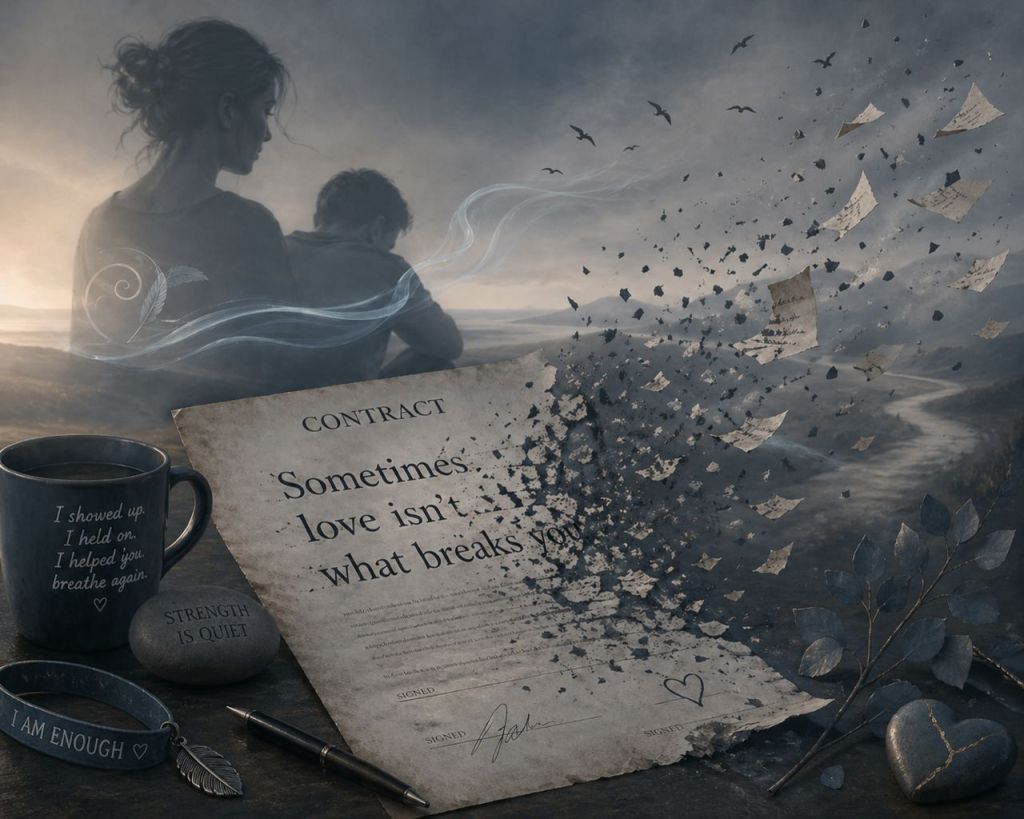
Sometimes love isn’t what breaks you.
Sometimes it’s the slow, quiet realisation
that you were loving alone.
And the bravest thing you will ever do…
is stop.


 Cheese & Jam
Leave a reply to Michael Ammo Cancel reply