
By Helene Waters – First publication March 22, 2026 by Cheese & Jam
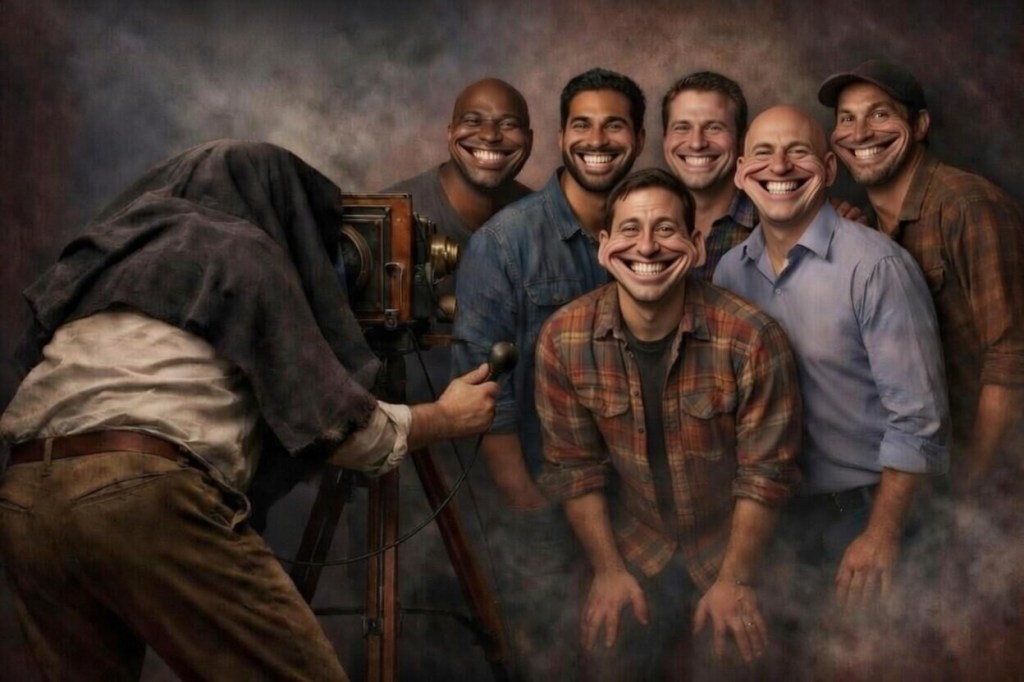
We’re lined up in front of the camera, shoulders squared, eyes forward, waiting for the click.
“Say cheese,” we’re told — and like clockwork, smiles stretch across faces. The shutter snaps, the moment is frozen, and the image is deemed perfect.
But what’s hiding behind those say cheese smiles?
Much like this familiar scene, men are often programmed to wear a smile — not because they feel good, but because they’re expected to look like they do. Strength is confused with silence. Vulnerability is mistaken for weakness. And so the smile becomes a mask, carefully practiced and permanently worn.
Why?
Because from a young age, men are taught that their emotions are inconvenient, uncomfortable, or unacceptable. “Man up.” “Be strong.” “Don’t cry.” Over time, those messages don’t just silence feelings — they teach men to hide them behind something more socially acceptable: a calm expression, a joke, a grin that says I’m fine even when they’re anything but.
And the longer that smile is worn, the harder it becomes to take off.
Because when you’ve spent years being praised for your composure, your resilience, your ability to “handle things,” admitting that you’re struggling feels like failure. It feels like letting everyone down — especially yourself. So men don’t just hide their pain from the world; they hide it from themselves.
This is where the damage begins.
Unspoken pain doesn’t disappear. It settles. It embeds itself into the nervous system, into the way a man relates to stress, conflict, intimacy, and love. It shows up as anxiety that has no obvious cause, anger that feels out of proportion, emotional numbness, or a constant sense of being on edge — hyper-vigilant, waiting for the next thing to go wrong.
And when that pressure becomes too much, when the smile finally cracks, men are often left asking a terrifying question:
What’s wrong with me?
The answer is usually nothing.
What’s wrong is that they were never given permission to hurt.
So they cope the only way they know how — by finding something that quiets the noise. Alcohol. Substances. Work. Sex. Gambling. Distraction. Anything that numbs what they don’t have the language, safety, or support to confront. These coping mechanisms aren’t moral failures; they’re survival strategies born out of silence.
And this becomes even more complicated in relationships — particularly those with imbalanced power dynamics.
When a man enters a relationship where his voice is diminished, where he’s controlled, criticised, or constantly made to feel not good enough, the smile doesn’t disappear. It hardens. He learns to shrink, to placate, to stay quiet in order to keep the peace. Outwardly, everything may look fine. Inwardly, he’s disappearing.
By the time he leaves — if he leaves — the damage is already done.
He may move on. He may find someone kinder, safer, more loving. But the trauma doesn’t automatically stay behind. It travels with him, unresolved and unnamed, waiting for the moment it feels safe enough — or overwhelmed enough — to surface.
And when it does, the smile returns.
Because that’s what he was taught to do.
And when the pressure becomes unbearable — when the body is exhausted and the smile can no longer hold — the brain goes looking for answers.
But instead of turning toward the present wound, it often reaches backward.
It searches for old, familiar trauma and places the blame there. Childhood pain. Past losses. Earlier abuse. Events that are already acknowledged, already named, already accepted as “the reason.”
Because facing the truth — that the damage was done more recently, more quietly, and by someone who was supposed to love and protect them — is far too painful.
Admitting that means confronting years of survival. Years of silence. Years of staying when leaving felt impossible. And for many men, that truth threatens their sense of identity, strength, and self-worth.
So the mind protects itself the only way it knows how.
It redirects the pain.
The darkest demons, the most shadowed shadows, hide behind this redirected pain.
They thrive in the places that remain unnamed. Unexamined. Unspoken.
They feed on PTSD that has no clear origin, on anxiety that feels constant but inexplicable, on addictions that promise relief and deliver ruin. They sit quietly at the back of the mind, patient and undisturbed, while the vessel — the man — slowly and systematically begins to fall apart.
Not all at once.
Not loudly.
But piece by piece.
Sleep erodes. Focus fades. Joy becomes unfamiliar. The body stays in a constant state of alert, braced for a threat it can’t identify. And because the true source of the pain remains hidden, the mind turns inward, assigning blame where it’s safest: I’m broken. I’m weak. There’s something wrong with me.
And so the demons are allowed to stay.
Because as long as the pain is mislabelled, they don’t have to be confronted.
When those demons finally begin to scream to be heard, that is when many men — especially those battling addiction — reach what is referred to in the world of psychology as hitting rock bottom.
For men, this moment is often uniquely devastating.
Because instead of asking for help, they turn inward. They self-destruct in the most profound ways — isolating themselves, sabotaging relationships, destroying careers, numbing themselves into oblivion, or convincing themselves that everyone would be better off without them.
This isn’t a lack of strength.
It’s the consequence of carrying pain for too long without language, permission, or support.
Rock bottom isn’t the beginning of the damage.
It’s the moment the damage can no longer be contained.
And by the time a man reaches it, he has usually exhausted every other way of surviving in silence.
Many men do not survive this devastating stage because the social stigma surrounding male failure is still unfairly equated with weakness.
This stigma is not abstract — it has measurable, fatal consequences.
The Calgary Health Foundation notes:
“The greatest evidence of male vulnerability is found in suicide statistics. Among Canadians of all ages, 75–80% of all suicides are male. Rates of suicide in Canada have remained fairly constant since the 1920s, averaging approximately 20 males and 5 females per 100,000 people annually. Statistics without context are easily glazed over, but every day, eight men lose their lives to suicide.”
https://www.calgaryhealthfoundation.ca/our-blog/eight-men-every-day/
These numbers are not a reflection of emotional fragility.
They are evidence of silence, shame, and a culture that still teaches men to endure pain alone.
However, the men who do claw their way back from this edge do so for one defining reason:
They decide they want their lives back.
They reach a point where they no longer wish to be ruled by the demons that have dominated them for years — where control, once taken from them, is consciously reclaimed. Not by denying the pain, but by facing it. Naming it. Owning its origin.
This isn’t weakness.
It is one of the most difficult acts of strength a human being can undertake.
A man who undertakes this work — this brutal, honest, internal reckoning — deserves support, understanding, and zero judgement.
Because real healing for men does not look dramatic.
It looks quiet. Intentional. Often uncomfortable.
Real healing looks like this:
- Owning mistakes without being consumed by shame
- Acknowledging pain instead of minimising it
- Connecting with other men who share lived experience
- Actively setting boundaries
- Creating structure and routine
- Slowing down — even when the world demands speed
And even these steps are rarely taken with confidence. They are often accompanied by self-doubt, fear of rejection, and the persistent question: Am I doing this right?
Healing is not linear. It is fragile in its early stages.
What healing does not look like:
- Denial
- Ignoring or numbing the pain
- Waiting for others to rescue or fix things
- Searching for instant solutions
- There are no shortcuts here. No quick wins. No performative strength.
Only honesty. Consistency. And the courage to stay.
Strength, by definition, according to Merriam-Webster, is:
“The capacity to exert, withstand, or resist force, pressure, or stress, encompassing physical power, mental resilience, and structural integrity. It signifies intensity, validity, or a specific advantageous attribute.”
But this is not the strength being spoken of here.
This strength is quieter.
It is the soft inner voice that refuses to give up.
The solitary tear shed in private.
The deep ache for acceptance — and the courage to keep going anyway.
It is the willingness to face what hurts, to sit with discomfort, and to do the hard, unglamorous work of moving forward.
Because the truth is this:
You never truly move on.
You only ever move forward.
Forward — stronger than your demons.
Wiser than yesterday.
And proud of the man you are becoming.
Resources:
Hooked On Hope
Newport Institute
 Cheese & Jam
Leave a comment